What is Veskald: a no-code strategy builder and quant lab for crypto futures
Veskald is a no-code platform for building, testing and running crypto futures strategies. Strategy building, backtesting, validation and analytics in one interface - and execution the way you want it: signals for trading by hand, a bot on your machine, or your own executor in between.
VESKALDPublished · Updated September 10, 2026 · 11 min read
Veskald is a no-code platform for building, testing, validating and running trading strategies on crypto perpetual futures, with market analytics built in. You describe a strategy as a set of rules instead of writing code, test it on history with real trading costs, check whether the result holds outside the period it was built on, and then run it - either by acting on signals yourself with the full market picture in front of you, or through an open-source bot on your own machine. The platform never holds funds and only accepts read-only exchange keys.
This page explains what the platform does, who it is for, what makes it different from a bot service or a charting tool, and what it does not do.
Who it is for
Traders who have a strategy in their head but no code. You know when you enter, where the stop goes, when you take profit. Turning that into something testable usually means learning Python or paying a developer. Here it means writing the same rules into a builder.
People who already write code and are tired of rewriting it. Every variation of an idea means another script, another set of bugs, another evening spent on plumbing instead of the strategy. When a strategy is a configuration, a variation is one changed parameter and a rerun.
Anyone checking a strategy they bought or copied. Most sold strategies are a handful of conditions. Rebuild them, run them through the same validation as your own, and see what they are actually made of.
The full cycle in one place
Many traders glue together four or five tools: a charting service for the idea, a backtesting framework, an optimizer, a bot service for execution, and a spreadsheet to put the results together. Context is lost at every seam.
Veskald keeps the whole cycle in one interface:
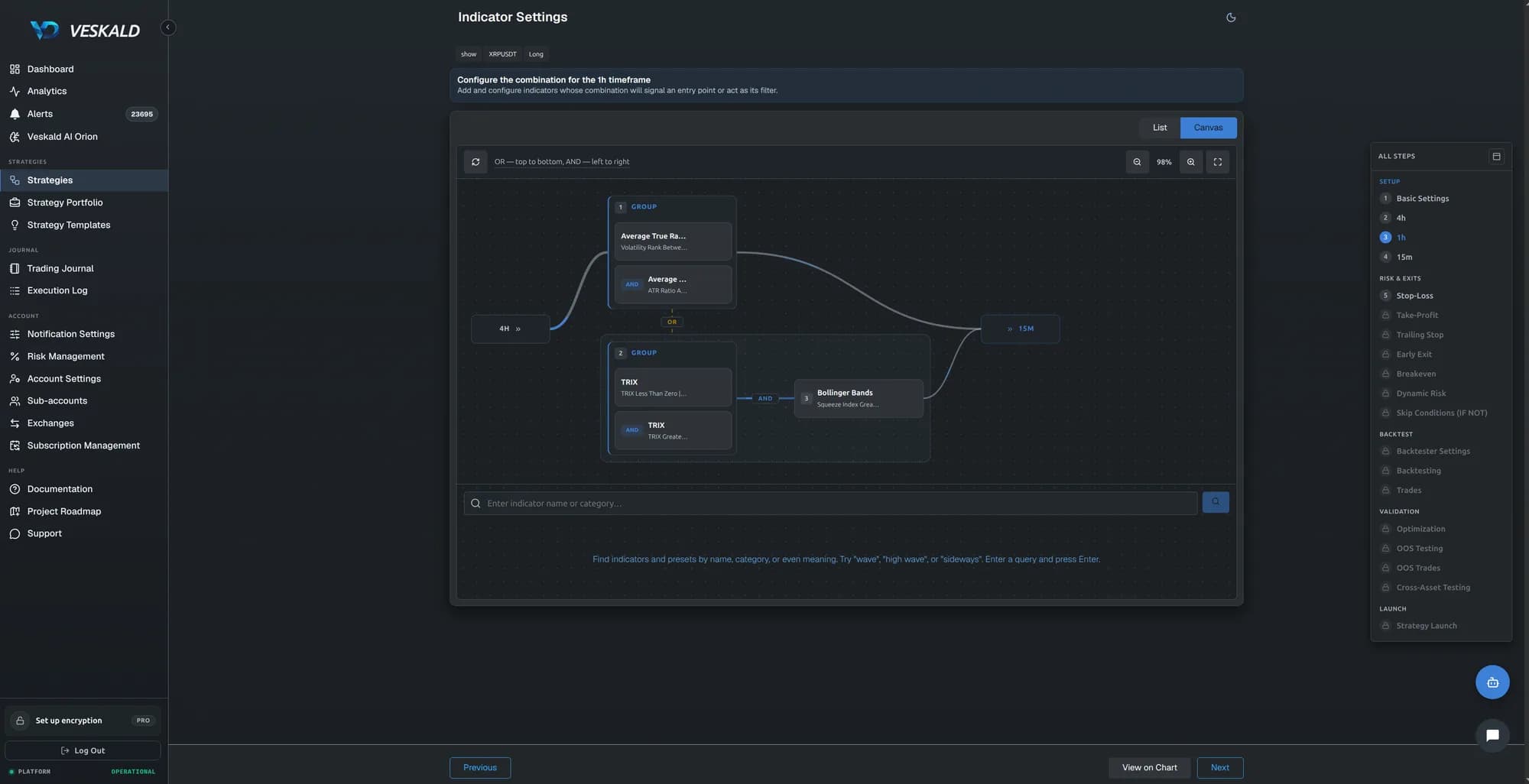
Builder. Entry conditions across several timeframes - for example, the 4h chart sets the trend and the 15m chart times the entry. Stop-loss, several take-profit levels, trailing stop, break-even, early exits by indicator or time, skip rules for when not to trade, dynamic risk that reacts to a series of outcomes. An indicator can drive any exit. Every rule is readable in plain language. Start from a blank strategy, your own templates, or the public library - strategies researched by the AI agents and published with all logic open to read and change.
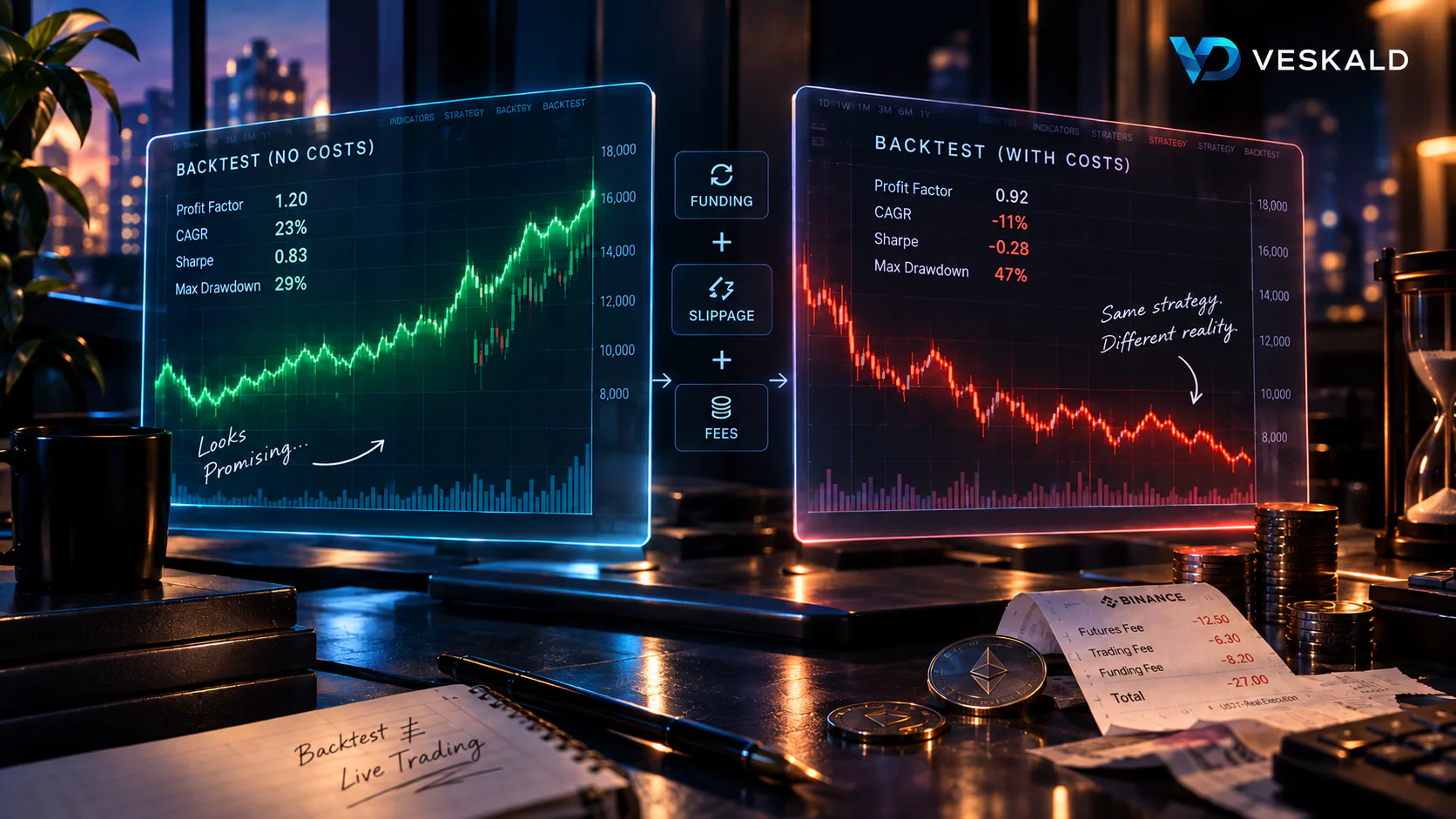
Backtest. The engine counts what a live account pays - fees at your exchange tier, funding on perpetuals, slippage from liquidity, price impact on large orders - and sizes positions by the exchange's own contract rules, so the size in the test is a size the exchange will accept. On small trades the gap between test and live comes out under 0.5%. The engine settings are open per strategy, and you can see how every trade is counted. Every trade is also clustered by the market regime it happened in - volatility, trend, volume, momentum, order flow, session - per timeframe, with the best and worst regime marked, so you see which conditions made the money and which quietly burned it. The report names the problem regimes outright: a toxic regime, a low win rate cluster, the regime where the edge lives.
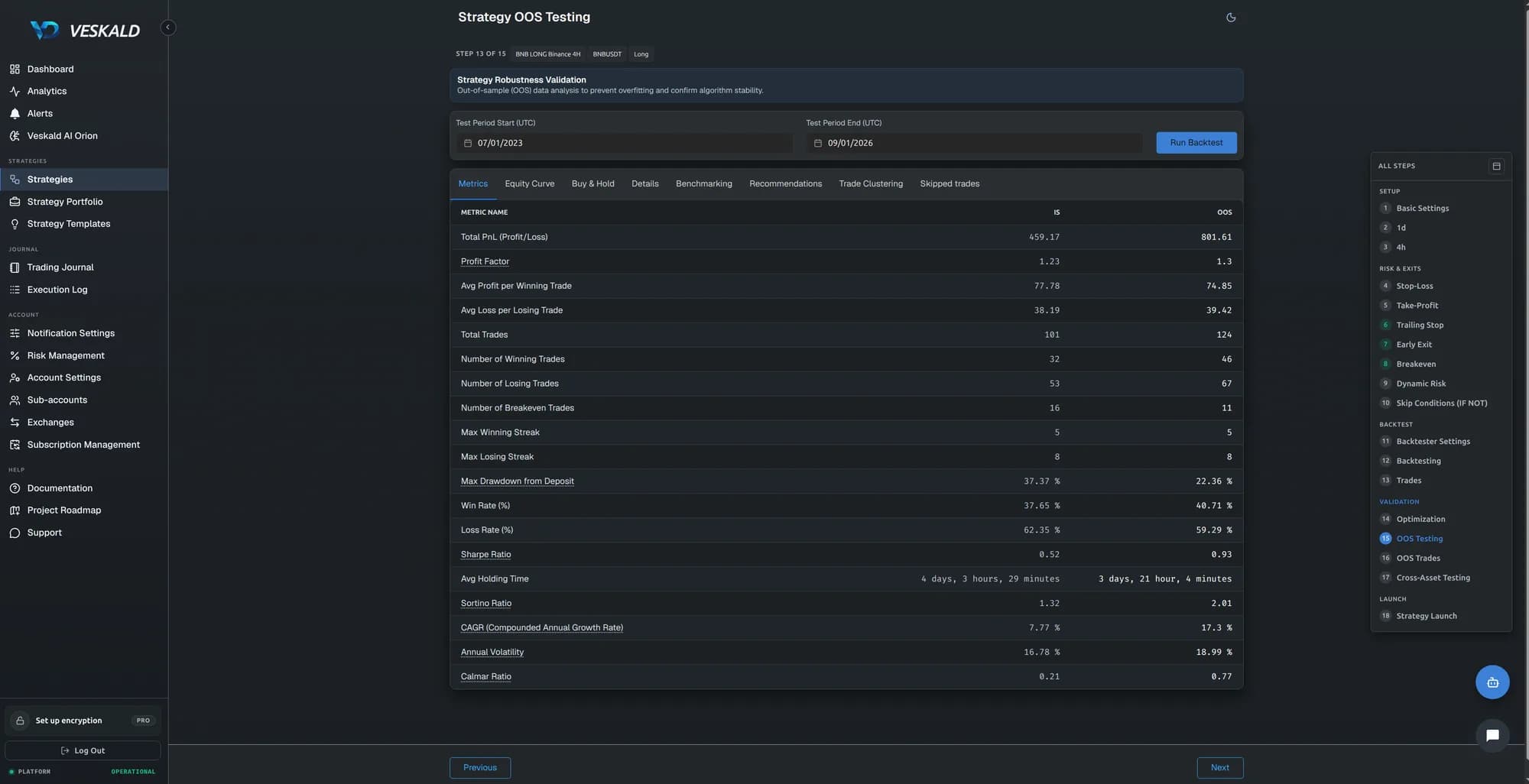
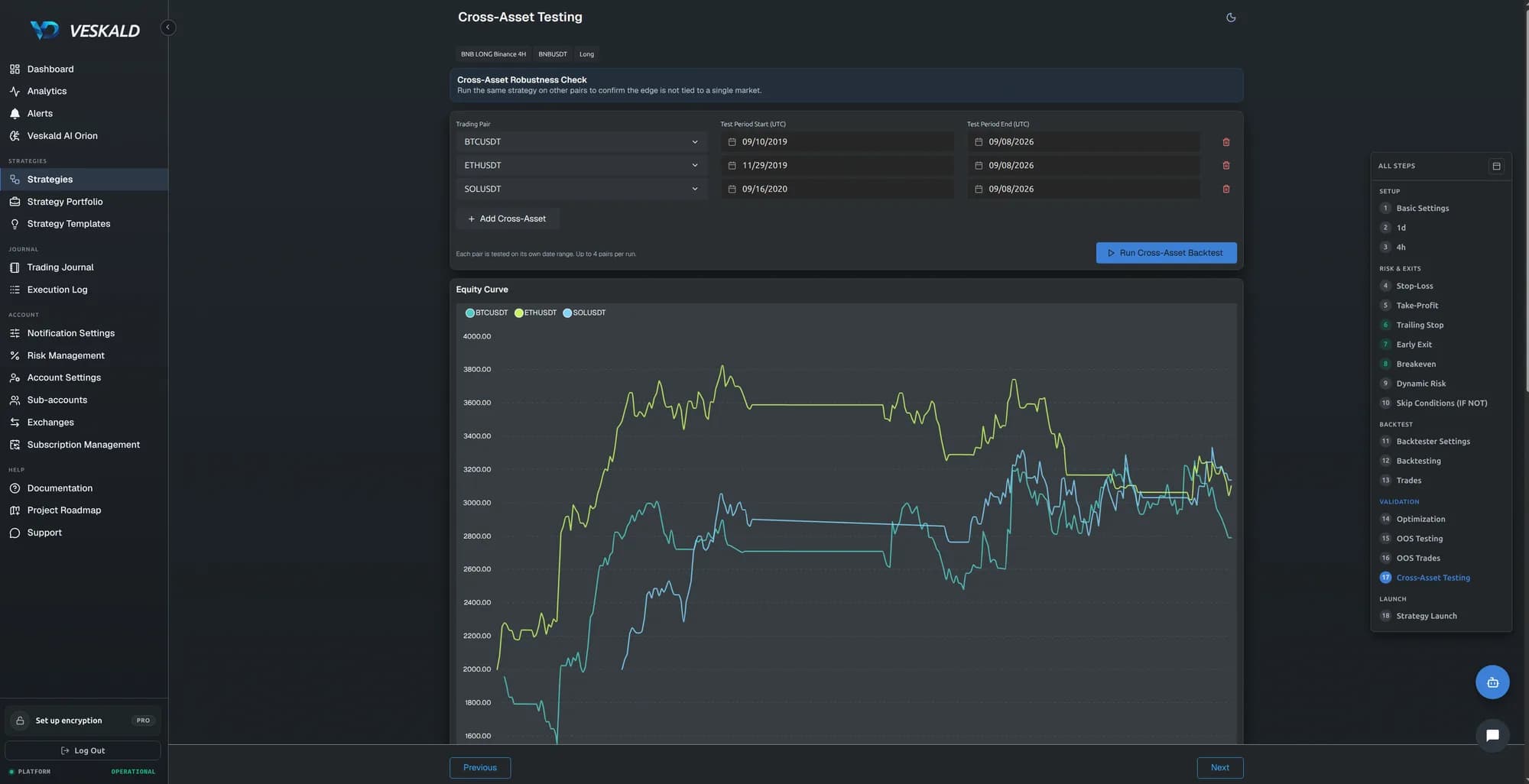
Validation. In-sample / out-of-sample split, Monte Carlo on the trade sequence, and cross-asset runs on other pairs. This is where a good-looking backtest either survives or turns out to be one lucky period.
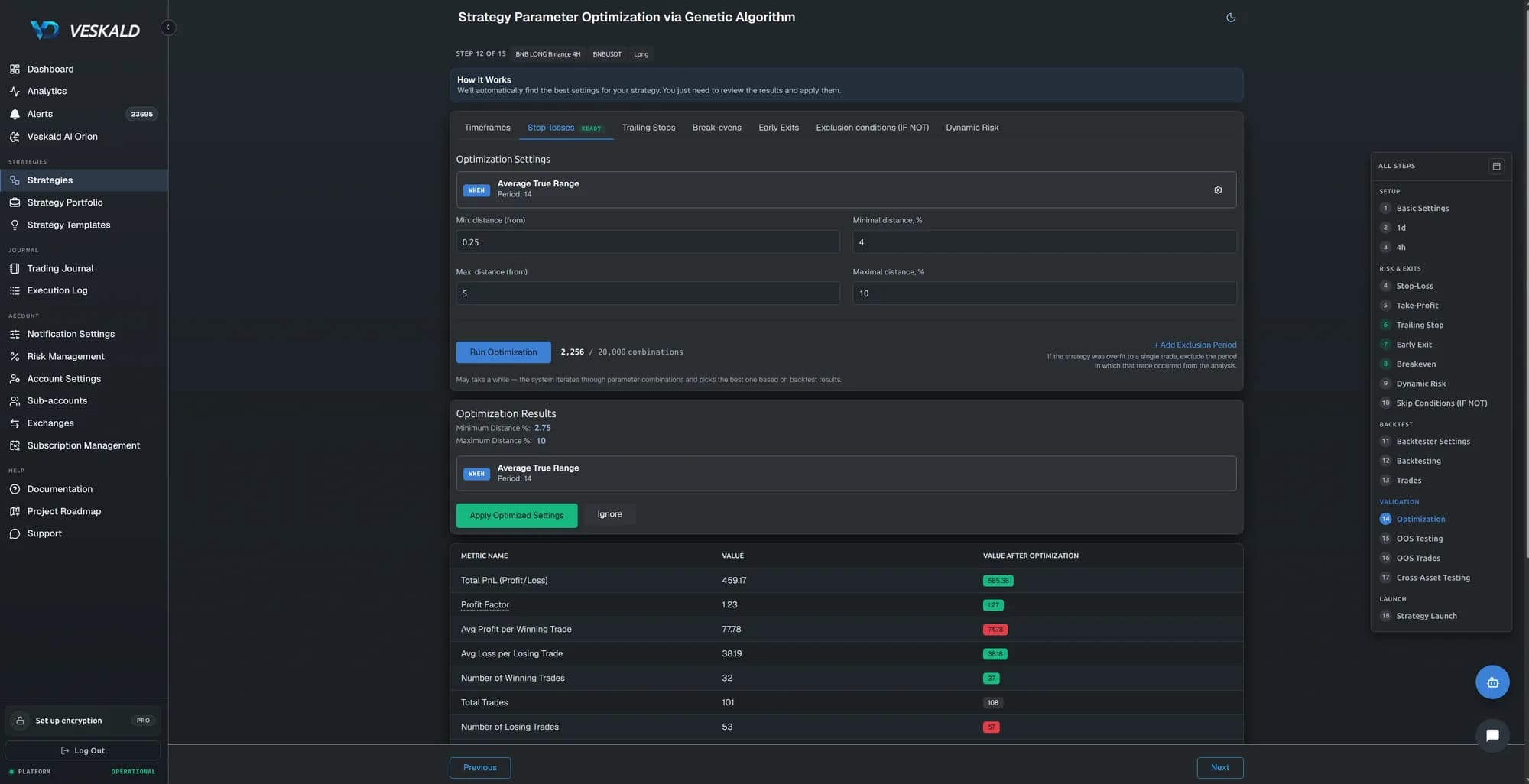
Optimization. A genetic optimizer goes through thousands of parameter combinations. It optimizes for a smooth equity curve rather than maximum profit - one lucky trade means nothing - which is what keeps it from fitting to noise.
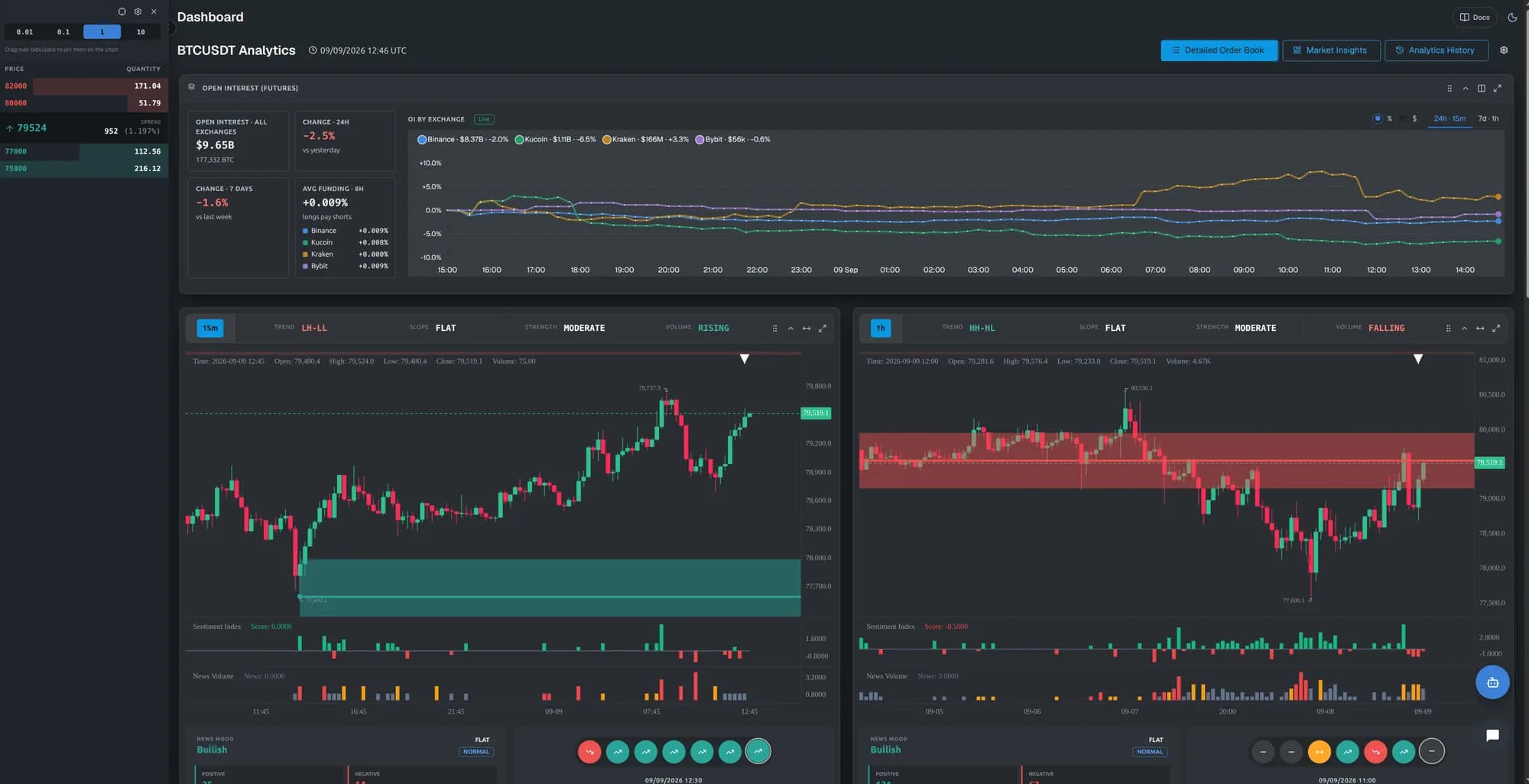
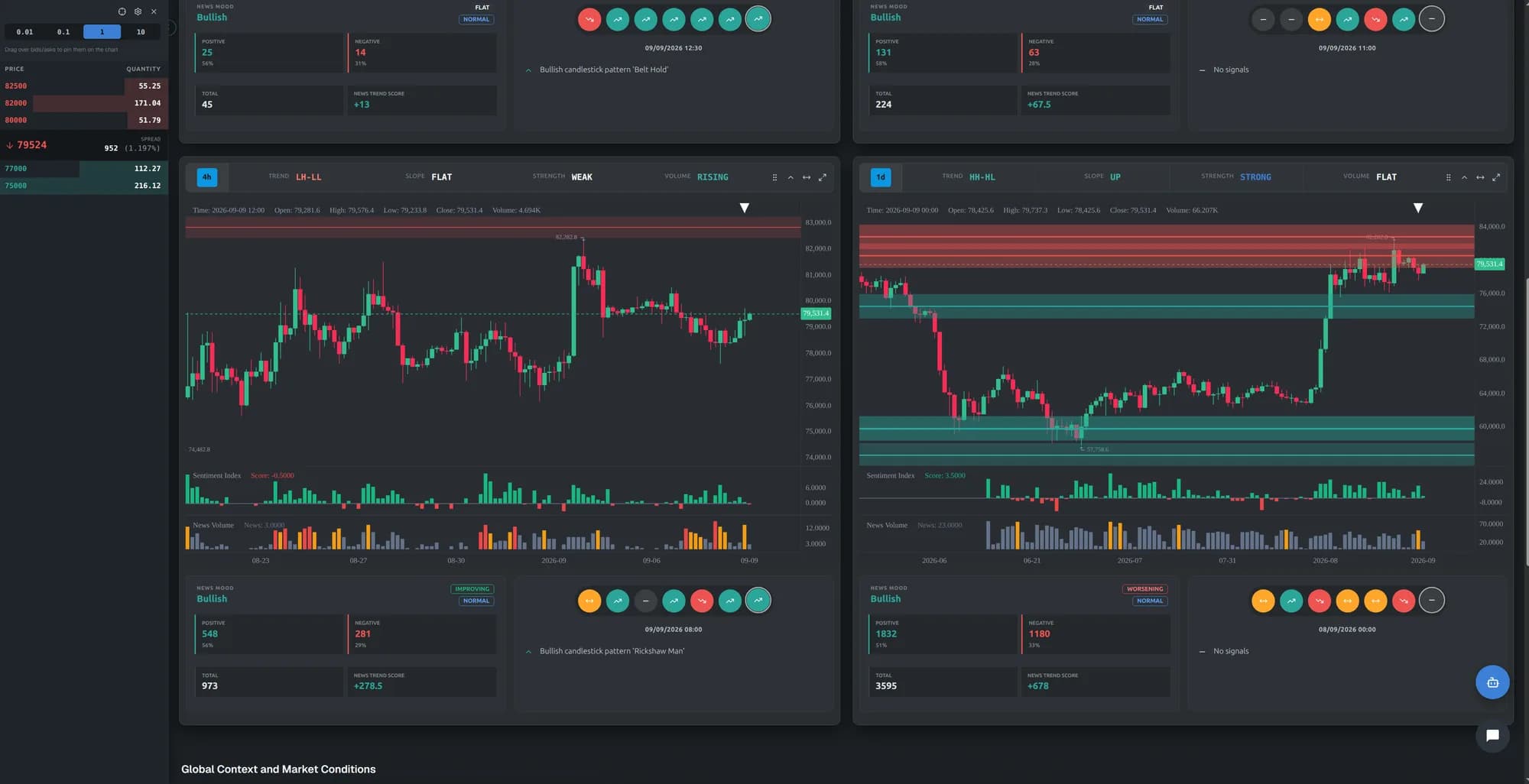
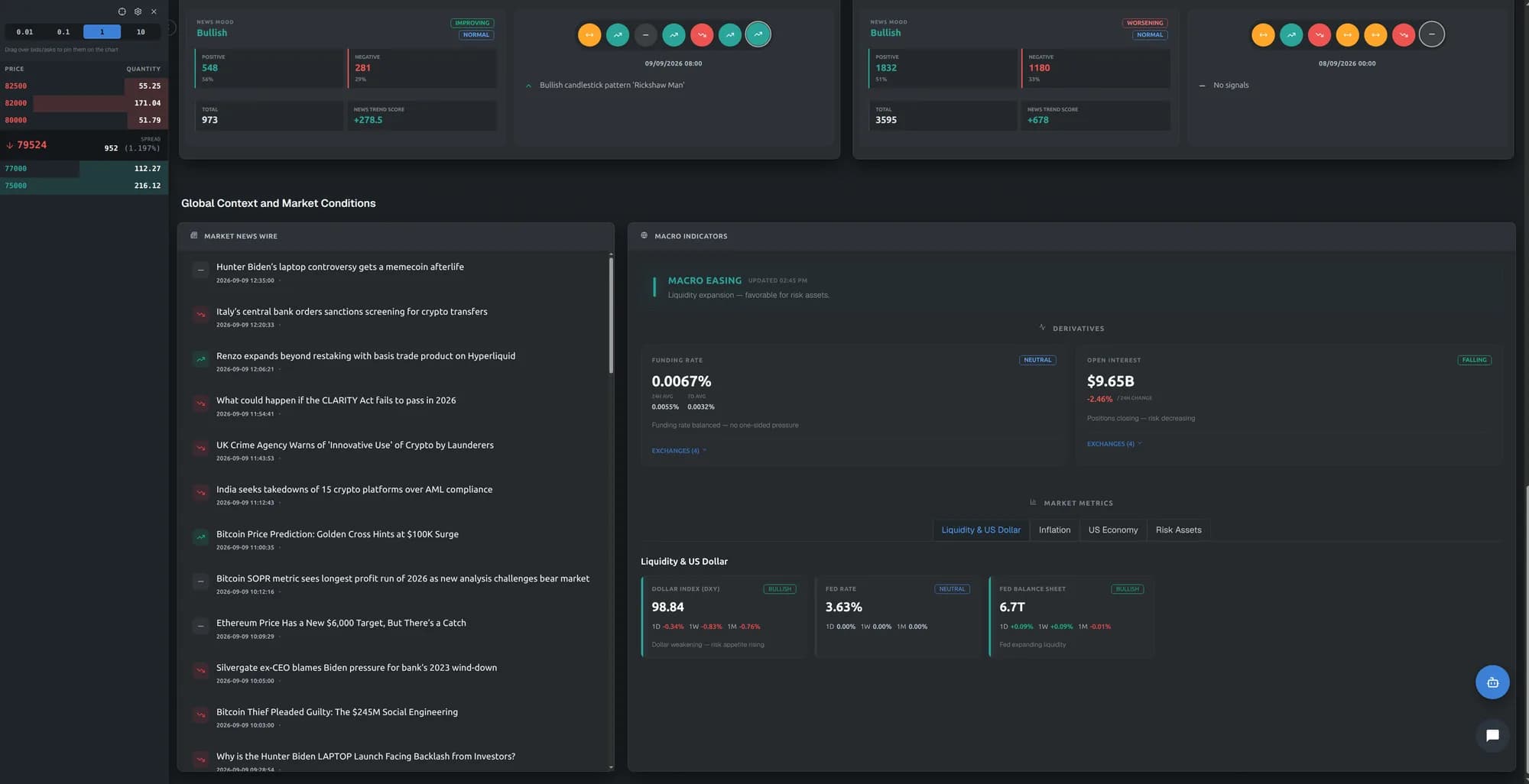
Analytics. One screen that answers "what is the market like right now" - red flags across four timeframes, order book depth, market regime, funding and open interest, news scored by AI. Used at the moment of a decision, and kept as history.
Execution. Three ways to run what survived - see below.
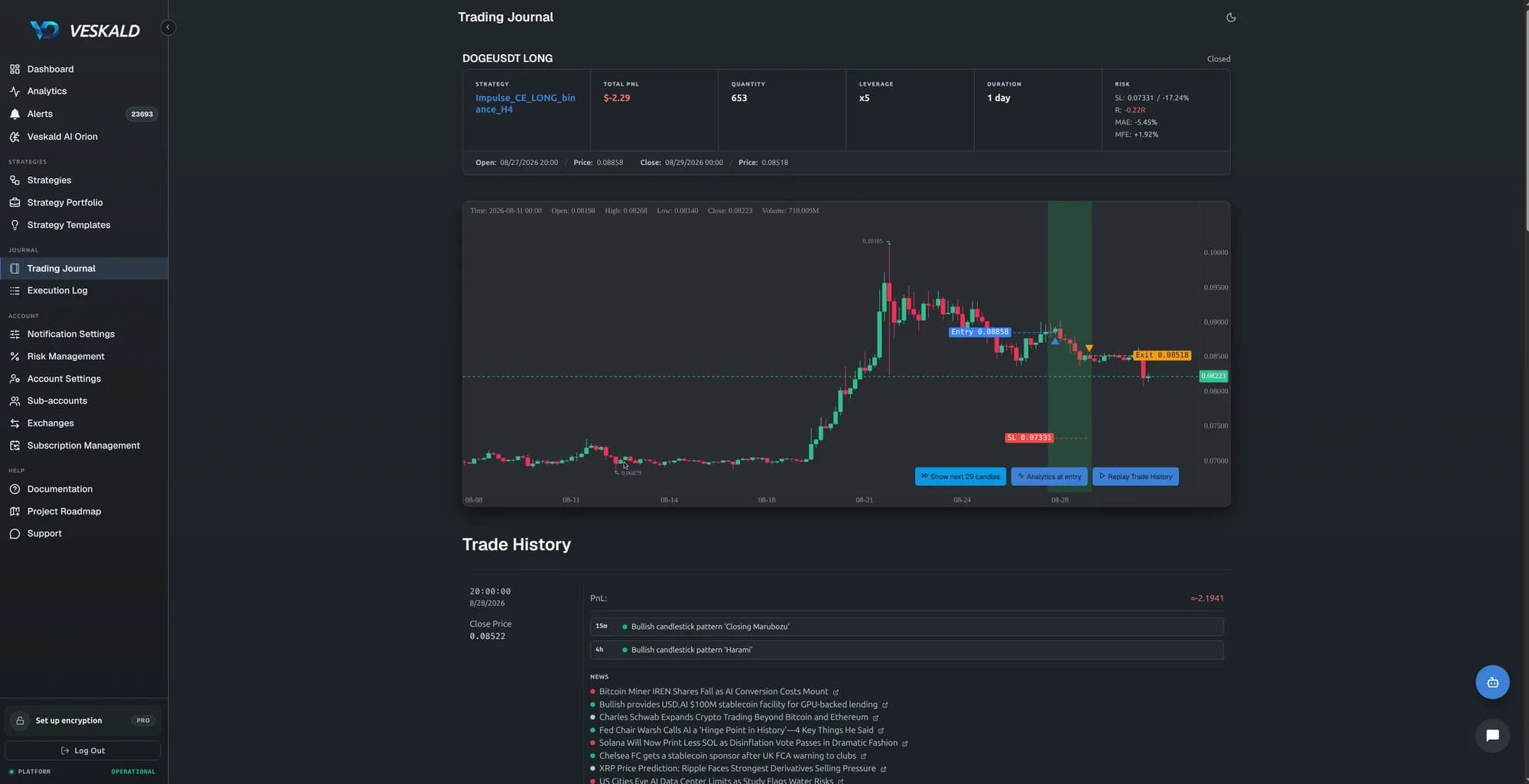
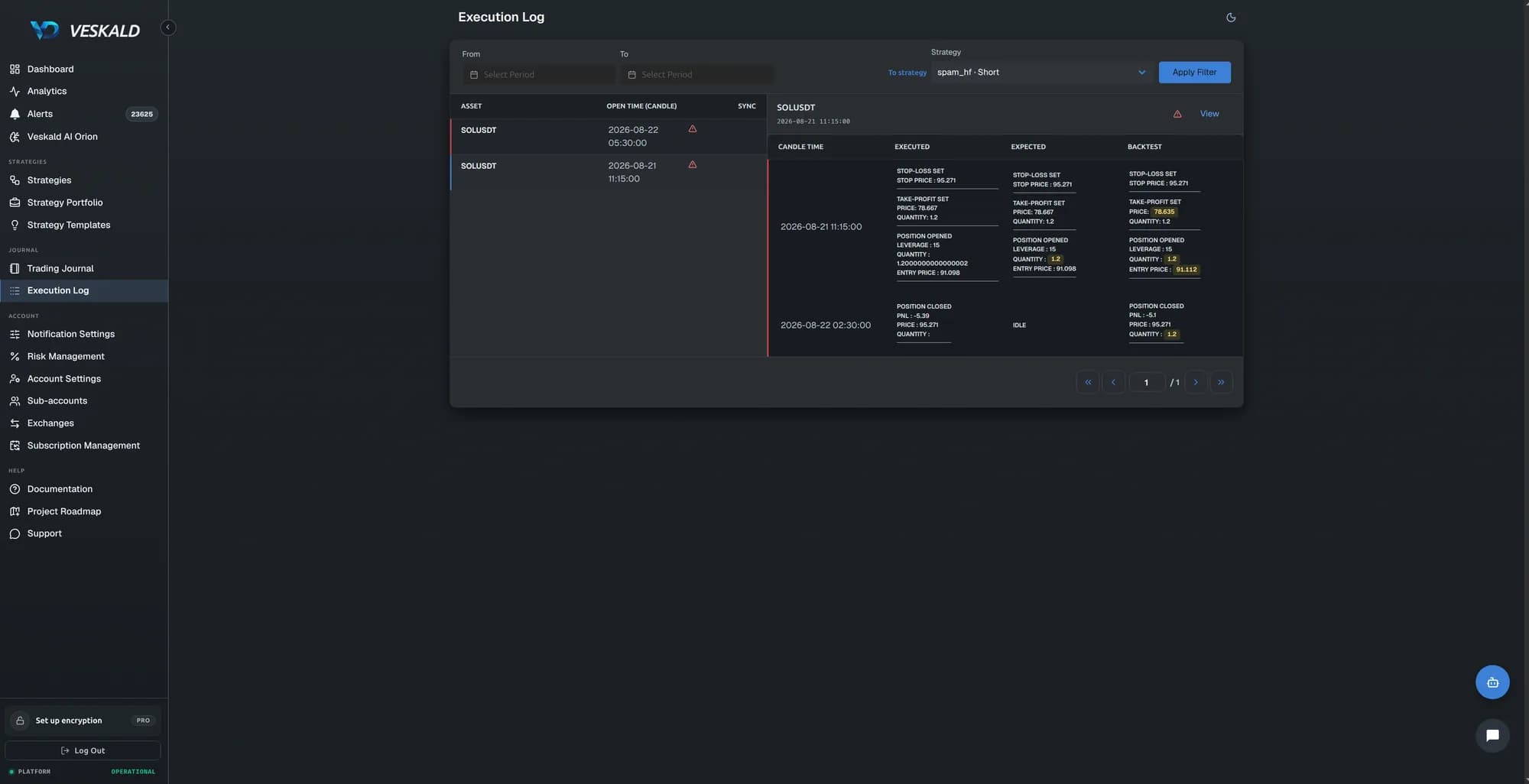
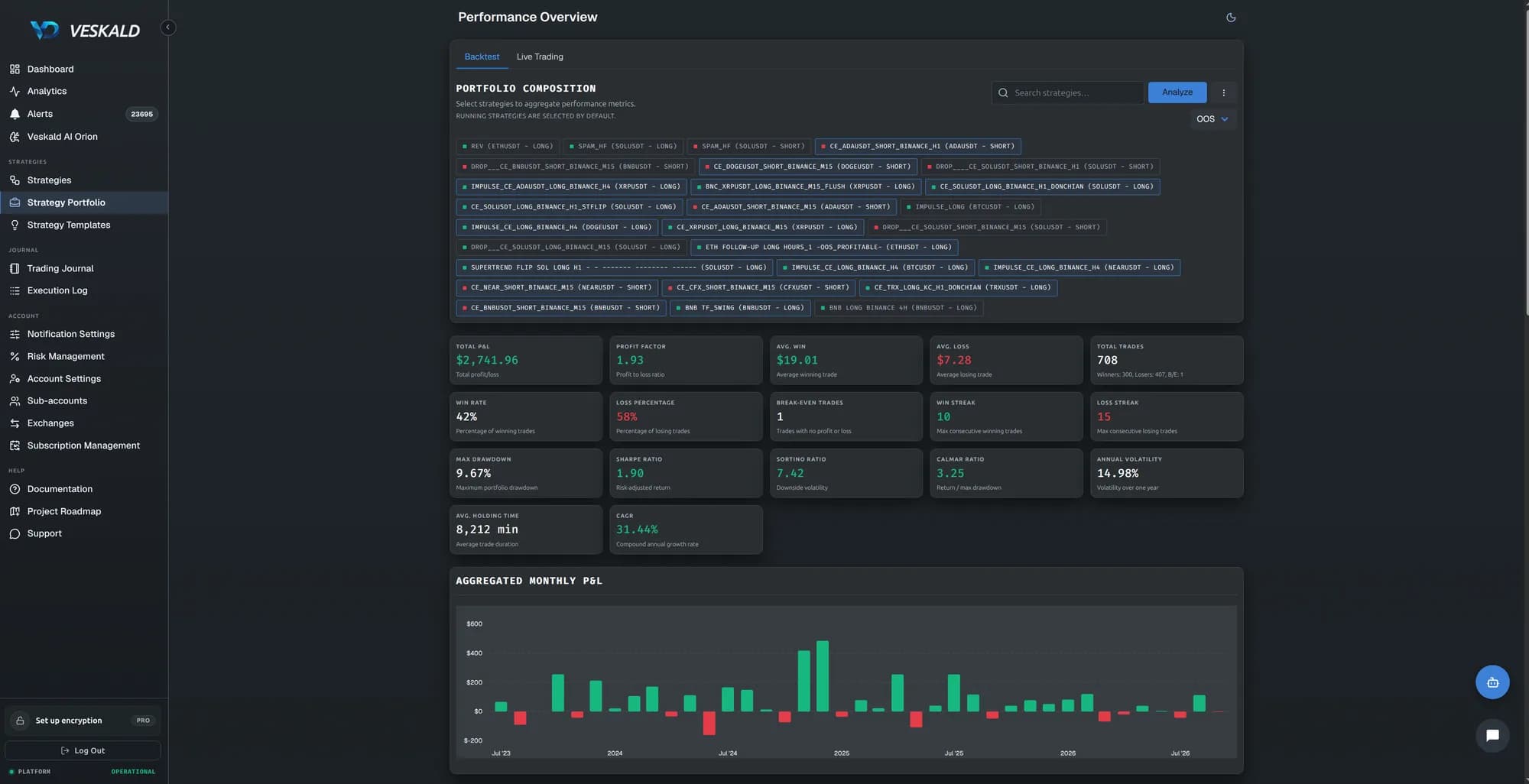
Journal, execution log, portfolio. The journal fills itself from the account and replays any trade candle by candle with the news, red flags and your own actions at the time. The execution log keeps the ground truth: every order and fill with the exchange timestamp, each backtest order next to its real fill, your manual interventions separated from the strategy. The portfolio shows all strategies as one book - combined equity, and a correlation matrix on drawdowns that catches "different" strategies making the same bet.
Strategy as rules, not code
This is the part that makes the rest possible. A strategy in Veskald is not a script. It is a configuration: indicators and their parameters, a tree of AND/OR conditions, stops, exits, risk rules. The engine reads the configuration and runs it - on history for a backtest, on the last closed candle in live.
Two things follow from that.
First, testing a variation takes minutes. Change the stop distance, add a skip rule, move the entry to a different timeframe, rerun, compare. A dozen versions in an evening is normal. Most of finding an edge is killing ideas that do not work, and this makes killing them cheap.
Second, the same rules run in the test and in live. There is one modelled difference: on history, an entry is placed at the open of the next candle. Everything else - stops, sizing, leverage, exits - is the same code. There is no second implementation to drift from the first.
Analytics for the decision moment
A strategy tells you when. Analytics tells you what the market is like at that moment. The screen combines red flags across four timeframes, order book depth, macro regime, funding and open interest, and news with multi-layered AI scoring - one view that answers "what is going on right now".
In semi-automated trading this is where the decision happens: a signal arrives, you open the screen, you take the trade or skip it with the full picture in front of you. And it keeps history - open any past day and see exactly what was on that screen at the moment of a decision you made, so a losing trade a week later is not a mystery.
Analytics also works on its own, without a strategy. It is the entry point for traders who want to watch the market with more context before they build anything.
Three ways to run a strategy
Signals. The strategy watches the market and sends a signal - in the app, as a browser notification, by email or to Telegram. You place the order yourself, with the analytics screen next to the signal.
Self-hosted bot. An open-source bot runs on your computer or server (Windows, macOS, Linux, or Docker) and places orders on the exchange. It is open and self-hosted for a reason: a signal from your strategy is your property, the same as the strategy itself, and what you do with it on your side is up to you. The bot is the default way to execute it - not the only one. Put your own filter in front of the signals, an ML model that decides which ones to take, or replace the bot with your own executor entirely. The execution path is yours to extend, not a service you hand a key to and watch. And because it runs on your machine, trading keys stay there and never reach the platform.
Both. Enter a trade by hand and hand it to the bot to manage - stops, take-profits, trailing. Switching between modes never means rebuilding the strategy.
For teams and custom setups, every strategy can also stream events over a WebSocket to your own endpoint, so you can build your own execution layer on top.
AI in design, never in execution
Three AI agents help with strategy work: one answers questions and reality-checks results on every page, one prototypes strategies fast, one does deep research - builds, validates, and says plainly when there is no edge. They use the same builder, backtester and validation tools a person uses, and every calculation is done by deterministic code.
They never touch execution. An agent cannot place an order, change a risk setting or reach your keys. Signals and execution are deterministic - the same input gives the same output every time. A language model can give two different answers to the same question, which is exactly why it has no place after the signal.
Security by architecture
The platform only accepts read-only API keys. A key with trading or withdrawal rights is rejected on submission. A trading key exists only if you run the bot, and it lives on your machine. It cannot be wired to the platform even by mistake: Veskald does not expose server IPs, so an exchange will not let a trading key work with our infrastructure at all. Veskald has no access to funds and no withdrawal path at any point. Strategies can optionally be encrypted with a two-key scheme, in which case even the Veskald team cannot read the logic. Data is stored in the EU.
What Veskald does not do
Hold or access your money. No custody, no deposits, no withdrawal path. Your capital stays on your exchange.
Place trades for you or hold your trading keys. The platform only reads. Execution happens on your side - by hand or through the self-hosted bot with keys on your machine.
Sell signals or other people's strategies. The template library is open logic you can read, change and test. Nothing is sold as a ready edge.
Promise returns or adjust backtest results. There are no "average user returns" here - we cannot see your P&L and do not control your strategies. What is shown is checkable: the test, the out-of-sample result, the Monte Carlo distribution, the regime breakdown.
Give verdicts. The platform does not tell you a strategy is good - it shows the data. If you ask, an AI agent will give you its opinion with the evidence behind it. The decision stays with you.
Create a false sense of security. Read-only keys, no server IPs to whitelist, open-source bot - the limits are architectural, not a policy you have to trust.
Scan the whole market. A strategy watches its pairs around the clock and alerts you the moment its conditions are met - but it runs on the pairs you chose, it does not scan hundreds of coins looking for a setup. Open interest and funding are context on the analytics screen, not entry conditions.
Anything outside crypto perpetual futures. Supported today: Binance, Bybit, Kraken, KuCoin. OKX and Coinbase are in development. No stocks, forex or options.
Support that builds
If an indicator you need is missing, tell us and we build it - it becomes a regular indicator available to everyone on the platform. When something in your strategy behaves in a way you cannot explain, we would rather look at your specific case than point you at a documentation page.
Getting started
The free plan gives 7 days to build and backtest, no card required; running a strategy live is on the paid plans. Take the strategy you already trade - from your head, from Pine Script, from a spreadsheet - and write it down as exact rules. You will see its numbers on years of history instead of your memory of it, where it makes and loses by regime, and whether it holds out of sample. If it does, it is ready to run without you at the screen. One session is usually enough.
This case study shows how a borderline profitable crypto futures backtest turns into a losing strategy once funding, slippage and fees are applied. Monte Carlo simulations reveal a 57% probability of loss after realistic costs are included.
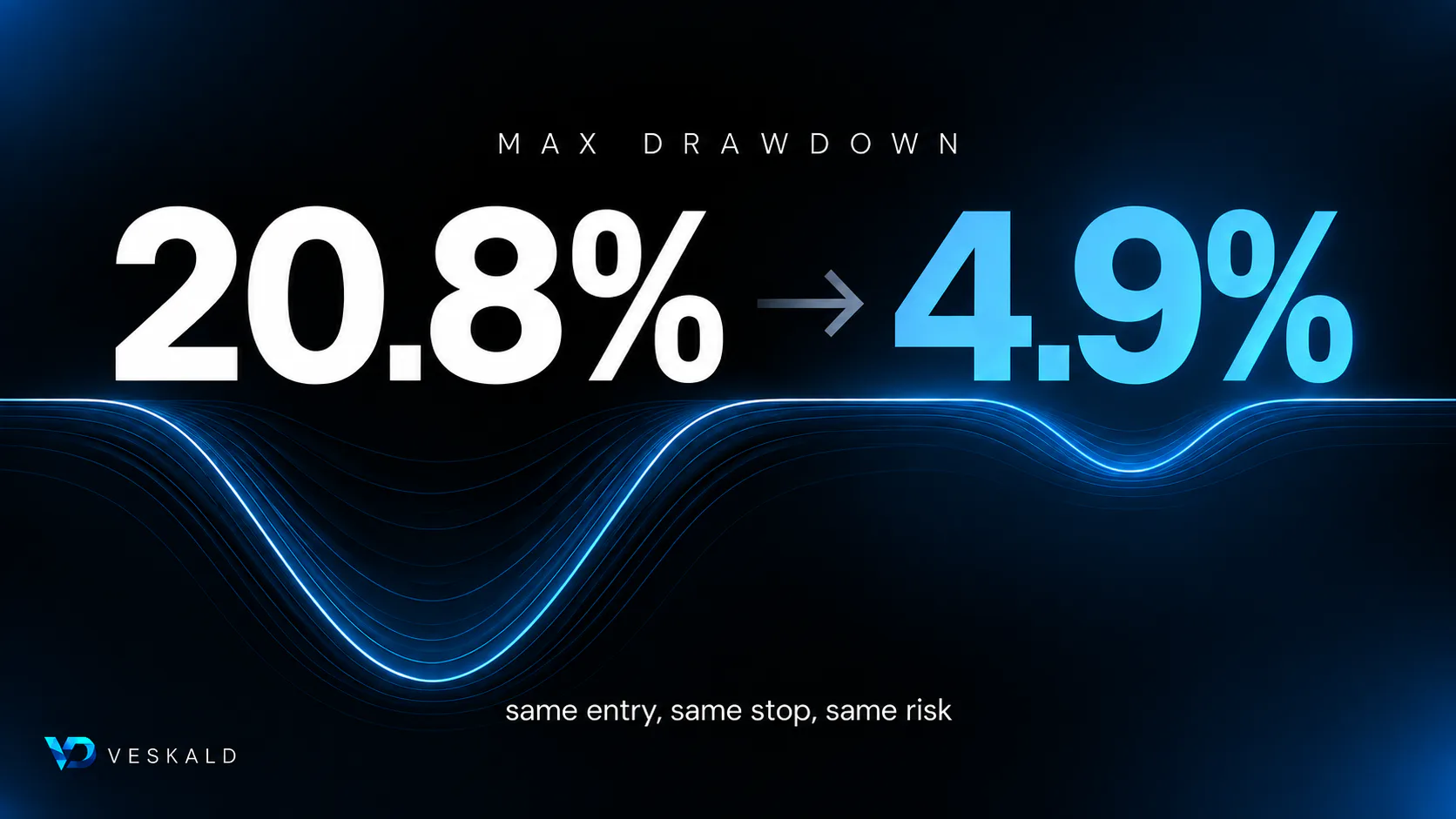
This backtest compares three exit strategies using identical entry rules to show how position management impacts drawdown and profit. Learn why the edge often lies in the exit rather than the entry signal.
Profitable trading relies more on position management than entry signals. Veskald lets you build entire trade lifecycles as editable rules instead of code, enabling rapid testing of exits, stops, and risk adjustments.